
Jackson County Tax Record Fields
Several offices build one property tax record: the Assessor values and classifies the parcel, local boards set budgets and rates, and the Department of Revenue approves the county roll. The Collector then issues the bill.
| Record field | What it shows | Official source |
|---|---|---|
| True value | County estimate under state appraisal rules | Tax Assessor roll |
| Property class | Category setting the assessment ratio | Assessor and DOR |
| Assessed value | True value times the class ratio | Tax roll |
| Exemption | Approved homestead or land-use treatment | Tax Assessor |
| Millage and tax | Rates applied and amount billed | Tax Collector bill |
| Payment status | Annual collection or delinquency | Tax Collector |
A large figure on a tax bill is not proof of unpaid Jackson County taxes. Before comparing any two amounts, line up the parcel, roll type, and tax year, and remember that living in a home does not by itself signal an exemption on the property records.
Search Jackson County Tax Bills
Through the Tax Collector property search, you can reach a Jackson County tax bill by owner of record, location, property number, or bill number. Pick your route along with the roll type and year. Location searches will not span every year at once.
- Choose one search route.
- Enter the owner last name first, or try the street alone.
- Select the correct roll type and tax year.
- Open View before any payment action.
- Save the PIDN, year, bill number, and receipt.
You can enter a full or partial property number. Bill lookups take a bill number, roll type, and year. Jackson County results can be viewed or placed in a cart, and any convenience fees should be confirmed within the live transaction itself.
Jackson County Tax Search Screen
The official search selector displays the available routes for Jackson County property tax records.
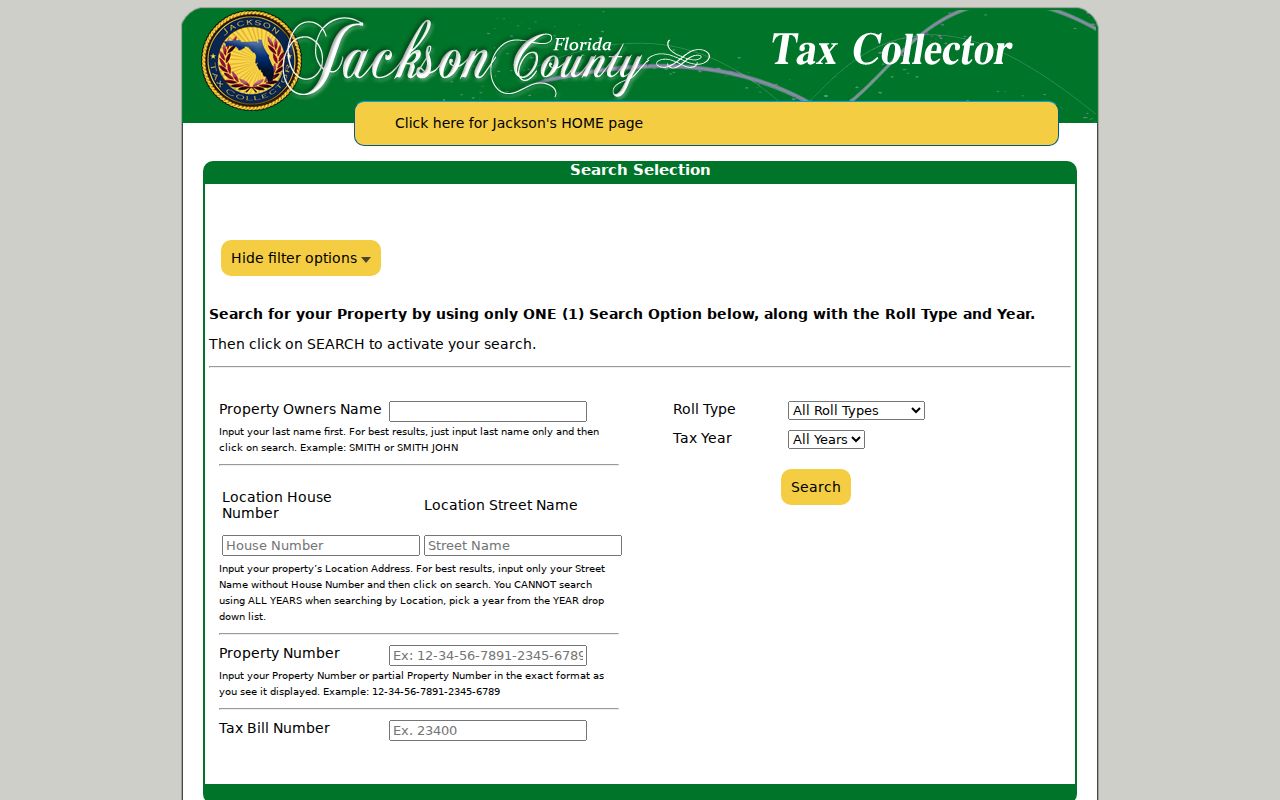
Note the search route and year before you rely on the results, so anyone repeating the lookup can land on the same page.
Jackson County Assessment Math
Mississippi taxes property with a simple formula. It is True Value × Assessment Ratio × Millage = Taxes. One mill equals one dollar per $1,000 of assessed value. A single-family, owner-occupied home falls in Class I, taxed at 10 percent. Most other real property sits in Class II at 15 percent. Personal property is Class III, utilities are Class IV, and motor vehicles are Class V. Class III runs 15 percent. But Class IV and Class V each carry a 30 percent ratio. The class a parcel lands in matters most. Nothing else in the math shapes its tax bill more.
- True value
- The appraiser's estimate under state standards.
- Assessed value
- True value multiplied by the class ratio.
- Millage
- Tax rate per thousand dollars of assessed value.
- Homestead exemption
- Approved treatment administered by the Assessor.
- Tax lien
- A legal claim tied to unpaid tax.
Millage can stack up from the county, the city, the school district, and special districts, so two similar parcels can carry different tax bills.
Jackson County Tax Calendar
Every value and exemption keys off the January 1 lien date. The Assessor's calendar lists April 1 for builder affidavits, homestead applications, and rendition work. The roll opens the first Monday in July. Protest and public-roll activity fills the final two weeks of July. County pages phrase the payment deadlines differently, one saying January 31 and another February 1. The Real Estate Taxes page offers the fuller timeline. Taxes paid through February 1 carry no interest. Monthly interest starts February 2. A publication charge lands July 15. The sale happens the last Monday in August. Confirm the current notice each year, since wording and dates shift. Note: Save the dated tax notice, because annual deadlines change and an old one may no longer control.
Jackson County Assessor Deadlines
The county's official Tax Assessor page lists the key dates on the Jackson County tax calendar.

Confirm the current year's form and receipt deadline with the office before filing anything.
Contest a Jackson County Assessment
The 2025 appeal form was a prior-cycle sample. It asked for the owner of record and the protested and requested values. The same form wanted the property address, subdivision, lot, block, and PIDN. Owners also supplied reasons, evidence, a signature, and a date. That window ran July 21 through August 4, 2025, closing at 5 p.m. The Assessor has not yet posted a 2026 form. Treat those dates as history rather than guidance.
For support, the form listed adjusted appraisals and arm's-length closing papers. It also accepted insurance declarations and certified income-and-expense records from set prior years. Ask the Assessor and Chancery Clerk for the current appeal form and its deadlines.
Deadline check. Confirm the current form, evidence years, office, and receipt time before submitting a Jackson County assessment protest.
Delinquent Jackson County Tax Records
A delinquent tax bill is one thing. A tax sale is another. A state tax-forfeited parcel is a third. A completed title transfer is a fourth. Start with the Collector's bill and payment timeline. Then move to the Chancery Clerk's sale and redemption deed records. If land has passed into state forfeiture, search the Mississippi Secretary of State inventory separately.
Along the way, preserve the parcel number. Keep the former owner of record and the legal description too. Note the tax year, the sale date, and the redemption status, and file the deed reference with them. A sale listing is a distress signal. It is not proof of marketable title.
Jackson County Tax Access Channels
Jackson County gives owners several ways to reach their property tax records. The tax payment application posts the current terms for online view and payment, while offices, drop boxes, mail, phone, and public-record requests cover the rest.

Keep every bill and receipt. Check card and e-check fees first. Each Jackson County channel sets its own charges. The amount you pay can shift depending on how you pay. The Collector's office answers balance questions. The Assessor's staff handles valuation and exemption issues tied to the parcel record.
Written requests work best when they spell out the owner of record, the address, the PIDN, the tax year, and the roll or bill number. Include the copy type needed, plus a return address. Under the Mississippi Public Records Act, the county may charge actual production costs.
Jackson County Exemption Records
Homestead and land-use treatment both sit with the Jackson County Tax Assessor. Its form library runs from the homestead documents and pre-application to a builder affidavit, agriculture and land-use applications, land-use value calculations, and the personal-property rendition. The personal-property rendition is there too. A mailing address that matches the owner does not prove an exemption was granted.
When you pull the parcel, check its class, exemption status, lien date, and tax year. An exemption change can move taxable value without any sale. Splits, combinations, demolitions, improvements, and land-use changes also shift the tax roll. Dispute the exemption itself by requesting the application and the decision behind it.
The Assessor lists April 1 as the homestead deadline, though the current office notice controls. Keep the filed form, the receipt date, and your supporting papers together. Keep the resulting roll entry with them.
Jackson County Value Review Evidence
Any review of Jackson County property records starts with two anchors: the PIDN and the legal description. Match those first. From there, lay the true value beside the assessed value, then check class, ratio, exemptions, and every millage that applies, whether county, city, school, or special district. Physical changes matter too. A parcel split, drainage work, demolition, new construction, or a recent arm's-length sale can each move a number.
Evidence requirements change with each appeal cycle. The 2025 form asked for adjusted appraisals, closing papers, insurance declarations, and certified income-and-expense records from named prior years, but those years were specific to that cycle. Get the current form before assembling a later protest.
Three traps deserve their own warnings. Never infer market price from assessed value without applying the class ratio. A high assessment does not mean delinquency, and a protest does not signal title trouble. Each of those is a separate record question.
Jackson County Tax Sale Checks
A parcel on a Jackson County tax sale list calls for careful note-taking. Record the owner or former owner, the location, the PIDN, the legal description, the taxable year, sale timing, redemption context, and any deed references. Then take the question to the custodians. The Collector can state the bill status, while the Chancery Clerk holds the sale, redemption, and recorded land instruments behind any parcel in the property records.
One statewide source sits apart from the county system. The Mississippi Secretary of State maintains a tax-forfeited inventory whose results appear ten at a time, and saving properties or auction actions there can require login. Any state listing should still be matched back to the county parcel and the clerk's deed records before it is trusted.
Keep the distinctions straight. A sale list is not a deed. A bid is not a completed transfer. Redemption cannot be judged from the tax value alone. Confirm the current event with the custodian before any purchase or title decision.
Offline Jackson Tax Records
Portals are convenient. But they have not replaced the office, the phone, the mail, the drop-box, the archive, or a public-records request. For bill and payment questions, the Collector answers at 228-769-3074. Appraisal and exemption questions go to the Assessor at 228-769-3070, option 4. Land Records, at 228-769-3131, covers sale, redemption, lien, and deed references.
A good written request names its target precisely. State the parcel, year, roll type, bill number, owner, address, legal description, and the exact record wanted. Ask for an estimate before any broad production. Under the Mississippi Public Records Act, search, review, copying, mailing, and some electronic-data costs may be charged.
County Archives adds the long view. It holds historic land rolls, tax receipts, Board minutes, newspapers, and Chancery cases that can explain older tax events. A present balance still comes from the Collector, and a present assessment from the Assessor.
Build an annual evidence set for each parcel instead of relying on a single screen print. Save the parcel search result and the bill. Keep the assessed and true values, the class, the exemptions, the millage details, the payment receipt, and any protest or board action. Label every item with its tax year and access date. When a figure changes, trace the cause before calling it a reassessment. A class correction, an exemption change, or a parcel split can each alter the final amount. So can a new improvement, a demolition, a city boundary shift, or a rate change. If two official Jackson County pages give different deadlines or charges, preserve both citations. Then ask the responsible office for the controlling notice. That habit keeps Jackson County property tax records tied to their proper year, channel, and custodian.
A blank online result is rarely the end of the story. Choose a specific year. Try the street without its house number. Enter the owner's last name first. Or search the property number in both full and partial form. Use only one route with a given roll and year. If the portal still fails, ask the Collector to verify the bill. After a parcel split or combination, ask GIS or the Assessor to confirm the current PIDN. Document the query and the error. A blank screen is not proof that no Jackson County property tax record exists. It is never proof that nothing is owed.