
Trace Former Jackson County Property Owners
Older owners surface only through recorded conveyances read backward, one linked instrument at a time. Pull the newest deed first. Copy the grantor, grantee, filing date, legal description, and book or instrument reference. Then chase that grantor's earlier acquisition. Jackson County spreads the trail across its online index, deed books, County Archives, and the Mississippi Department of Archives and History. Whatever the source, tie each former owner to the same legal description before trusting the link.
| Source | Years It Covers | Where Held | What It Shows |
|---|---|---|---|
| Chancery land index | Modern computer trail; pre-July 29, 2002 entries not official/verified | Online or Land Records | Grantor, grantee, date, instrument and description |
| Deed books and county microfilm | Earlier physical record trail | Chancery Clerk, Archives, MDAH | Recorded transfers and cited prior deeds |
| County Archives | Mainly 1875 forward | 2915 Canty Street, Suite S | Land rolls, tax receipts, Chancery files and newspapers |
| MDAH Series 1156 | 1820-1847 | State digital finding aid/archive | Jackson Court House District land-record context |
Work online for a recent Jackson County chain. Branch out to the clerk and archives once an image, cited book, or date falls outside reliable computer coverage. Save a call number at every handoff.
Build the Jackson County Deed Timeline
A working timeline keeps evidence apart from conclusions in Jackson County deed records. One row should mark one conveyance.
| Transfer date | Grantor to grantee | Instrument | Land key |
|---|---|---|---|
| Newest filed date | Current seller to current grantee | Instrument or book/page | PIDN plus legal description |
| Prior filed date | Earlier owner to that seller | Earlier deed citation | Same lot, tract, or parent parcel |
| Earlier book era | Indexed parties as written | Deed-book page | Subdivision or section-township-range |
A deed of trust only secures a debt, and a release merely discharges a recorded encumbrance. Neither counts as a transfer of Jackson County title.
Search Both Directions in the Jackson County Index
The Chancery Clerk's tutorial documents grantor and grantee fields, filing-date bounds, instrument number, book type, book and page, subdivision, lot and block, section-township-range, property description, and free-form searching. Search one narrow party and date range first. Use the land description to reject same-name hits.
| Index direction | Question answered | Backward-chain use |
|---|---|---|
| Grantee or reverse | When did this party acquire? | Find the earlier acquisition deed |
| Grantor or direct | When did this party convey? | Confirm the next transfer |
| Description fields | Is it the same land? | Match lot, block, subdivision or PLSS fields |
Search trust, LLC, estate, trustee, and personal-representative names exactly as the Jackson County index spells them. Check both parties when an entity's spelling shifts.
Put one name on each search form. Run spouses, trustees, alternate spellings, and entity variants separately. Combine only results that share land identifiers, and log the filed-from and filed-to dates for every search. A meaningful negative result depends on that discipline, and it keeps a broad surname sweep from merging unrelated Jackson County chains.
Walk the Jackson County Deed Chain Backward
The chain runs from the known deed toward earlier owners. Never leap from a directory name or tax list entry straight to a conclusion about Jackson County ownership.
- Find the newest conveyance for the exact PIDN or legal description and record the current grantee.
- Copy the grantor from that deed and search the same party as grantee in an earlier date range.
- Compare the new result's land description and cited prior book/page; follow a parent tract through any lot split or replat.
- Repeat until the chain reaches the computer boundary, an estate or tax deed, or a missing link requiring a physical book.
- Grantor / grantee
- The conveying and receiving parties named in an instrument.
- Chain of title
- The linked sequence of instruments affecting the same land.
- Reverse index
- The grantee-side route used to locate an owner's acquisition.
- Warranty / quitclaim deed
- Different conveyance forms whose legal effect must be read from the instrument.
July 29, 2002 Changes the Jackson County Route
The Aumentum land-record portal carries an express warning. Computer filings dated before July 29, 2002 are not official or verified, and the images themselves are conditional. The date is posted at the official source.
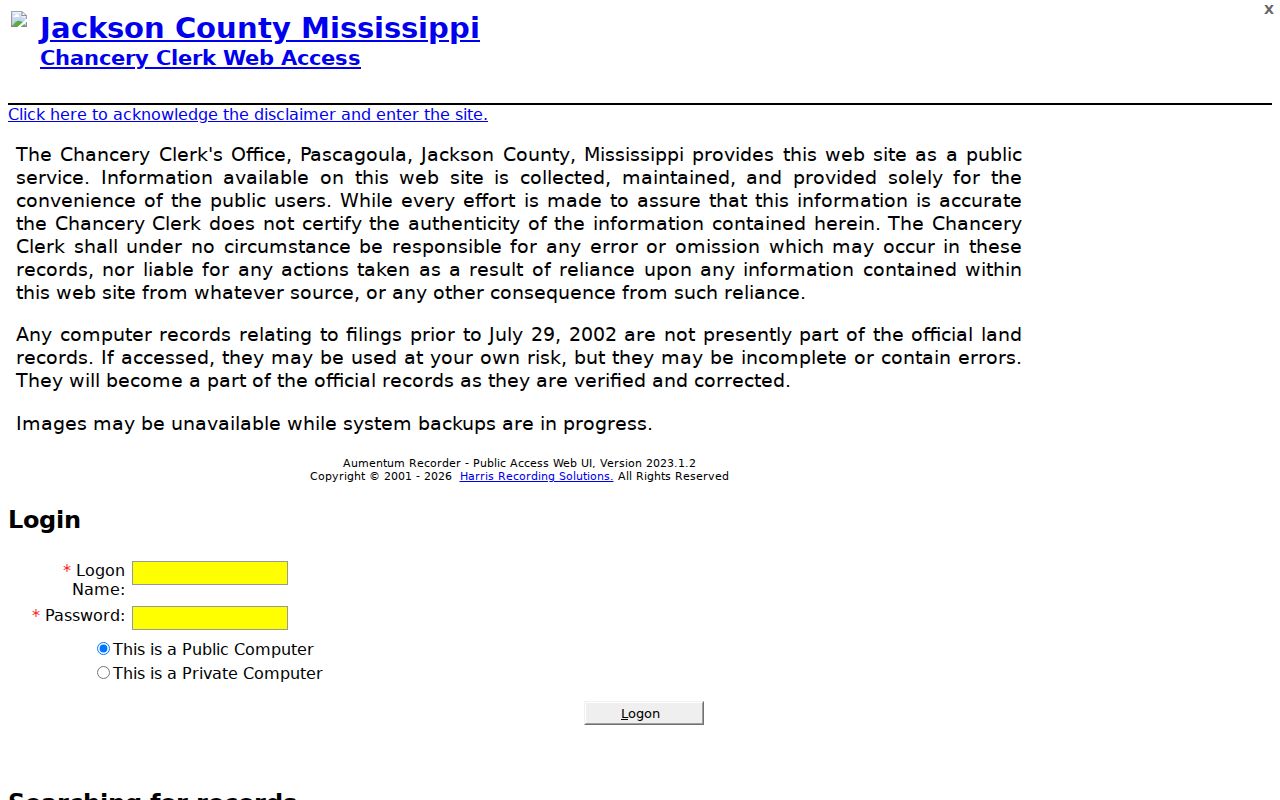
When a backward chain hits that date, write down the final reliable book and page and take it to Land Records. Visitors without escrow accounts can still search without logging in. Certification, though, still comes from the clerk.
Online cutoff. Older previous owners require deed books, microfilm, or archive holdings; do not infer a missing transfer from a blank portal result.
The 1875 Fire and Jackson County's Reconstructed Trail
Jackson County's courthouse burned in 1875. That fire explains the detour. Former-owner research may leave the continuous deed-book trail for reconstructed county material, state land claims, or microfilm. County Archives keeps land rolls and tax receipts. Its shelves also hold newspapers from 1875 to 1929, Board minutes, and Chancery cases reaching 1980.
MDAH widens the path. Series 1156 covers Jackson Court House District records from 1820 to 1847, alongside Series 1202 county items, Series 2050 original land and tax records, Series 456 transcriptions, and county microfilm. The Series 1156 finding aid maps a catalog route, not a substitute deed.
Let the Legal Description Outlast the Address
A former owner may hide under an old road label or a faded subdivision name. Parent tracts complicate it too. Jackson County records carry the fix. Plat-book and deed-book citations, lot and block, section-township-range, and adjacent PIDNs can help. They tie a changed address back to the same parcel.
A directory entry, newspaper clipping, photograph, or family paper shows occupancy and local history. Treat each as a clue. The Singing River Genealogy and Local History Library and County Archives can enrich a house history. The anchor stays the deed, plat, or court order.
Pascagoula proves the address problem. Its older street plan and named historic districts supply place clues a modern street search misses. Krebsville, Orange Avenue, and Front Street are among them. Gautier's Martin Bluff and Hickory Hills planning references can orient a tract. Ocean Springs' 2024 annexation may shift the municipal custodian for later planning records. None of that context replaces a linked Jackson County conveyance.
Note: Record the repository and call number. Do this whenever the chain leaves a county book for an archive collection.
Reach Jackson County's Older Record Keepers
Land Records sits at 2915 Canty Street, Suite R, in Pascagoula. It answers at 228-769-3131. County Archives occupies Suite S at the same address, reachable at 228-769-3415. Both offices generally keep weekday hours from 8 a.m. to 5 p.m. A mailed request moves faster with the right details. Name the known owner, the PIDN, the subdivision, a book and page, the date range you want, the copy type, and a return address.
The Mississippi Public Records Act can help, within limits. A narrowly framed request may obtain existing non-exempt instruments. The custodian has no duty to build a chain-of-title report for you, though. Expect possible charges for search, review, duplication, mailing, and electronic data. You may need something you can rely on legally. In that case, get the instrument itself or a certified copy from the clerk.
Work one record at a time at each repository. Ask for the next cited document rather than a whole history. A deed may point to an earlier book and page. That citation hands you the next retrieval key. An archive catalog entry yields a series, box, roll, or call number. A tax roll gives you a year and the owner's spelling. Keep those references in chronological order. It stops a quiet research gap from hardening into an assumed transfer.
Not every parcel moved by ordinary sale. Estate and court records can bridge the breaks in a chain. Request the complaint, order, judgment, or representative's authority tied to the land. Then track down any resulting deed or recorded order. Tax deeds and redemption records demand the full sequence too. A published sale list by itself never proves that ownership actually changed.
How Far Back Jackson County Ownership Records Go
The surviving trail in Jackson County reaches back to early nineteenth-century land material, but it does not arrive as one seamless online index. Two events split the path. The 2002 computer warning and the 1875 courthouse fire both push researchers away from the desk: first toward physical clerk records and County Archives, then toward MDAH series, microfilm, early claims, and patents. State or federal land evidence often explains how a tract began. Later county deeds carry the story through its private transfers. Mark every transition with its repository, date range, book, series, box, roll, or call number. That discipline lets the next reader tell a verified link from a gap that is still unresolved.
Keep the inquiry property-linked. Trace prior owners for title, estate, purchase, or house-history research. Previous owners are part of a parcel trail, not a broad personal profile. Never use the record trail to stalk, harass, or harm a living person.